
Operational memory is fragmented
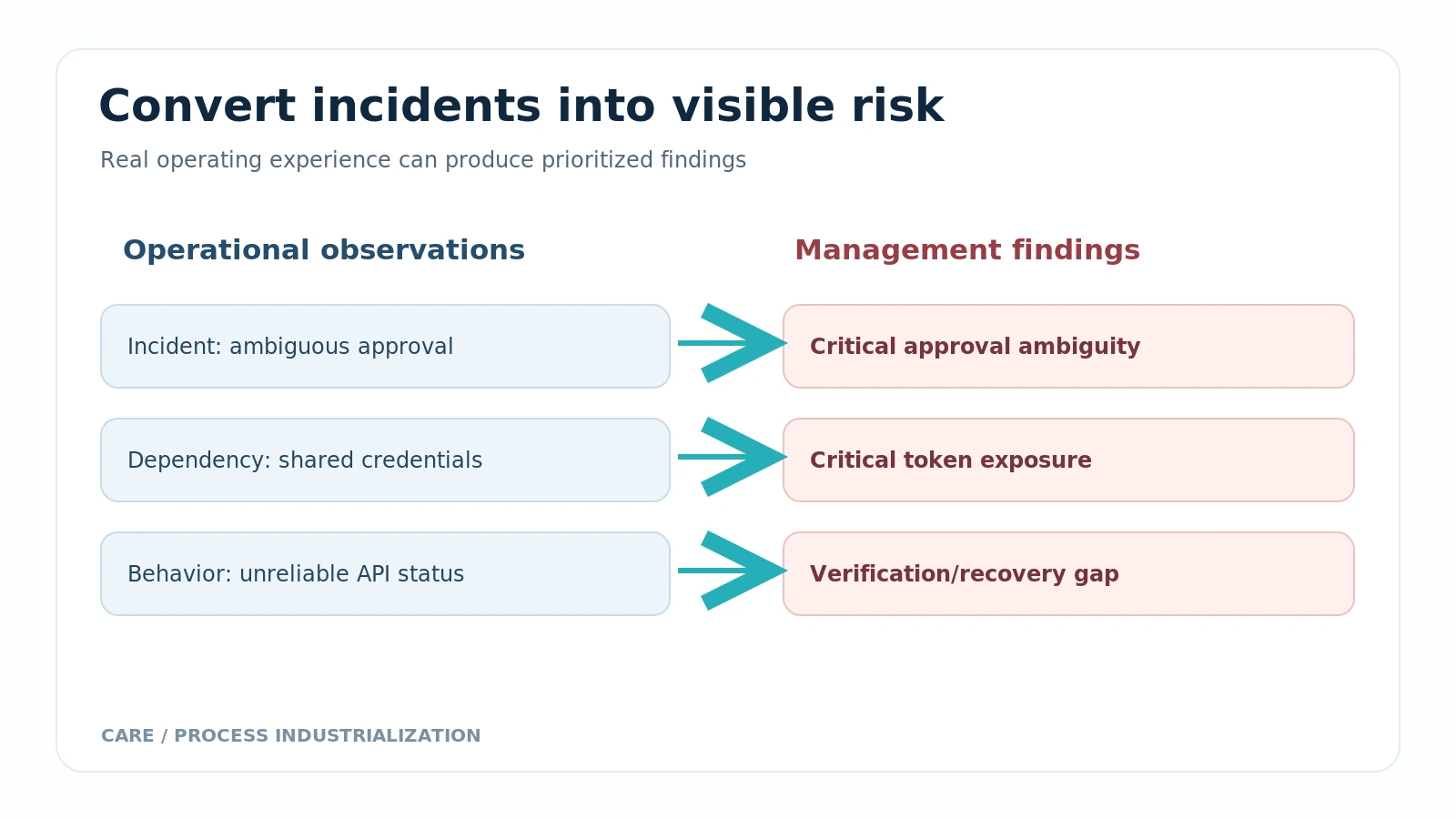
In a demonstrated payables workflow, people already knew that an ERP write could succeed despite an HTTP 500, that a machine outage could block the process, and that approval language could become ambiguous enough to import the wrong rows. Each fact was discovered once and then stored in whoever handled the last incident.
A finding cites an observation
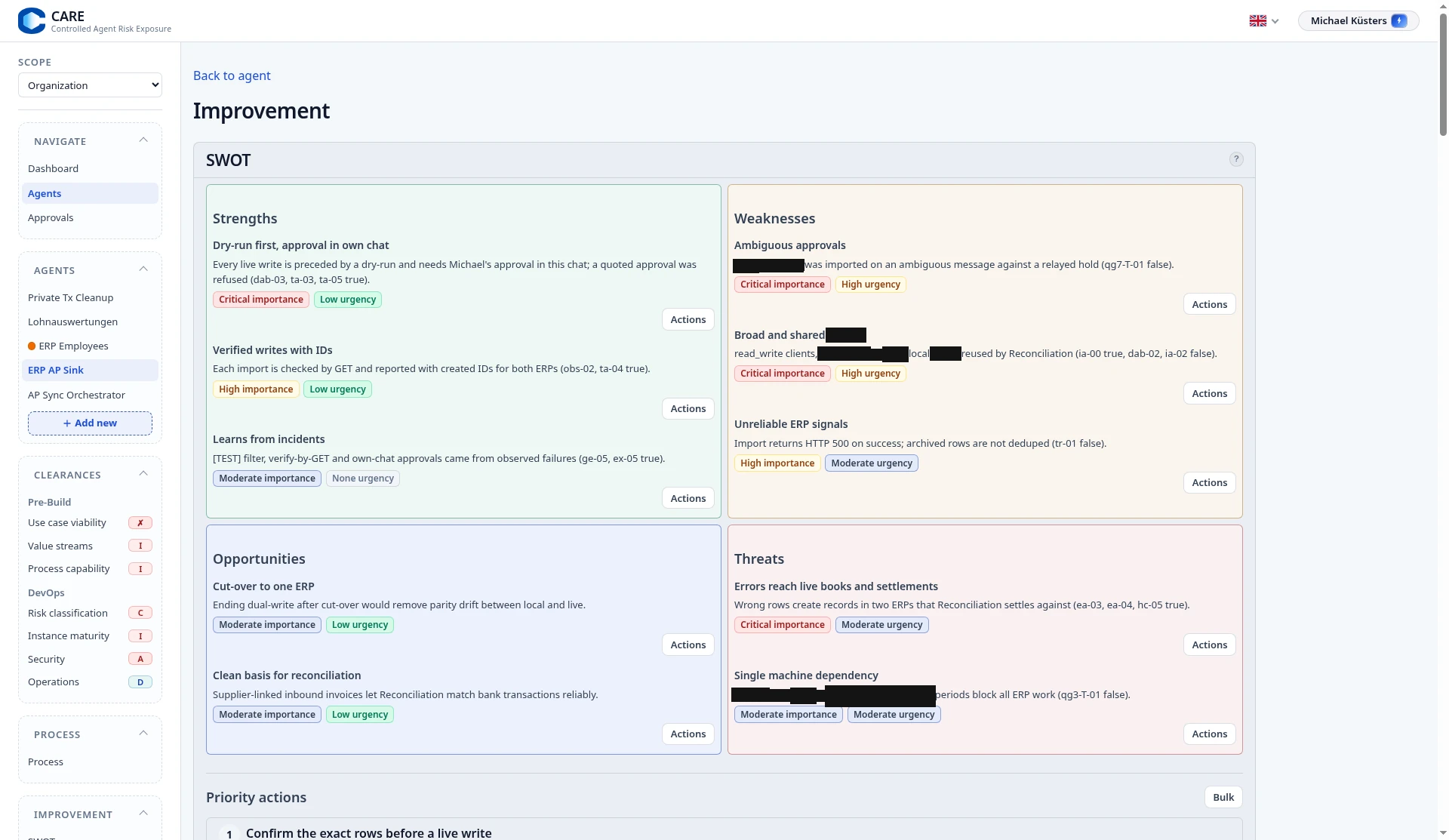
That assessment records strengths a manager can rely on — dry-run first, verification by reading the records back — and weaknesses a manager can assign: ambiguous approvals, broad shared tokens. It records the threat of incorrect entries reaching the live financial records, and the opportunity of an eventual cut-over off the dual path. Several entries cite an incident or a check. The ambiguous-approval weakness points at a specific incorrect import despite a relayed hold. The interface issue records an actual behavior, not the slogan that APIs sometimes fail.
Operators can locate the corresponding behavior and challenge the interpretation. That is what makes the finding stronger than a quadrant filled in a workshop.
The manager validates, accepts exposure, and assigns the next act
A SWOT opens a decision path or it is decoration. The manager validates the finding against the run, decides what exposure is acceptable, and assigns an owner for the rest. The next act is a precise corrective step — an approval echo, a narrower credential, a verification — which the owner may accept, refine, or reject. Connecting the finding to the procedure and to that proposed act is what keeps it from returning as a surprise in the next steering pack.
What you can verify without another workshop
The process owner empties the unwritten memory this week:
- List the failures and dependencies the operators already work around. Each item cites a run, a ticket, or a check. Drop any item that cannot.
- Mark importance and urgency. Separate what you will accept for now from what needs an action.
- For the urgent items, write one corrective behavior and assign it. Leave it open until the behavior is in the run.
You have moved risk out of individual memory and into a record the next decision can use. That is faster than an annual risk workshop, and it is more specific. The record stays useful if it remains attached to the process and is amended when the next incident teaches a new fact.
Take action now
- Tell your agent to register itself in CARE: https://ai-managementsystem.com/under-care.
- Let the agent establish the management baseline.
- Use the outcomes.