
Invisible handoffs are how control is lost
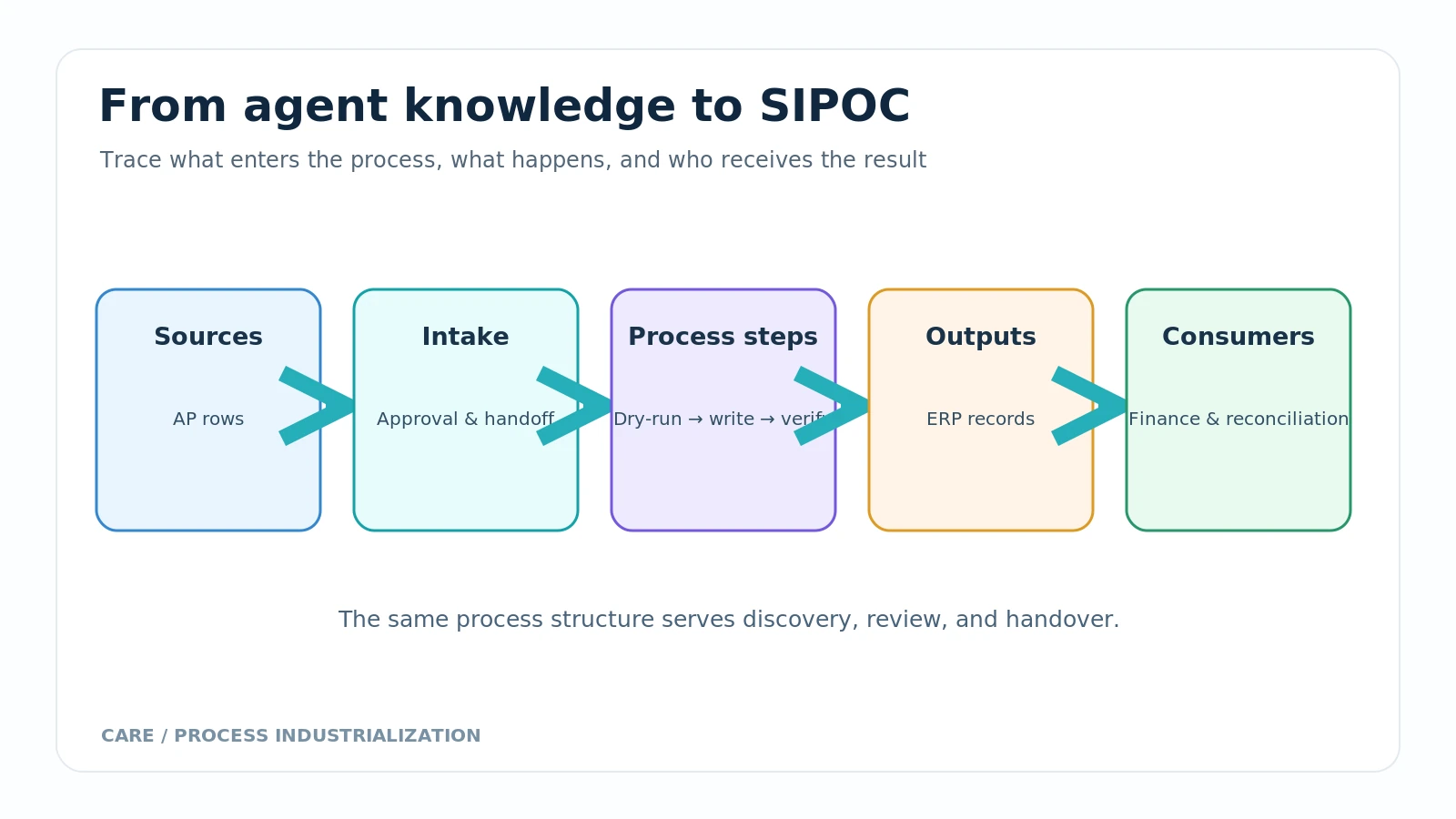
Accounts payable looks simple from the ledger: an invoice appears, then it is posted. Behind that line sit vendors and employees who send documents, a purchasing trail, people or agents who classify and extract, an approval that may or may not be real, an ERP write, a tax or audit consumer, and a process owner who is accountable when any of those links fails.
When those links stay implicit, the organization still runs. It simply cannot say what it is optimizing, what it is delegating, or what a provider is being paid to own. A task list names activities. It does not name dependencies. Until the dependencies are explicit, “improvement” can remove a delay by removing the only place approval actually entered.
Record the process as a SIPOC map
The management method is ordinary and durable: establish a SIPOC — Suppliers, Inputs, Process, Outputs, Customers — for the process under discussion, and name the process owner beside it.
What to record. For one process, write five columns and keep them short enough that an executive can read them in a minute:
| SIPOC | Illustrative accounts-payable example |
|---|---|
| Suppliers | Vendors, employees, purchasing |
| Inputs | Invoices, purchase orders, supplier master data |
| Process | Receive, validate, approve, post, reconcile |
| Outputs | Posted invoices, exception records, audit evidence |
| Customers | Finance, purchasing, suppliers, auditors |
That table is an illustrative business example, not a verified finding from any one demonstration. Replace every cell with the names your organization actually uses.
Why record it. The map makes three decisions possible without a workshop from memory: where a check must sit, which step may move to an agent or a provider, and who still owns the outcome when the step moves. It also surfaces the approval point as a named activity — or reveals that none exists.
How to record it. Ask the people and agents who perform the work to draft the five columns from the last completed run. Have the process owner strike anything that did not actually happen and add anything the draft omitted. Freeze that version as the operating baseline until the owner amends it.
Validate the map against how work actually runs
A map drawn from intention describes the brochure. A map drawn from a recent completed case — including the identifiers that actually appeared, the approval that actually occurred, and the recipient who actually consumed the output — describes the operation.
Validation is a management act, not a documentation polish. The process owner confirms the principal activities, the handoffs, the dependencies, and the authorization points. Where the draft and the last run disagree, the run wins until the owner deliberately changes the process.
Use the map before you change ownership
Once the baseline exists, improvement and outsourcing stop being abstract. Duplicate handling becomes visible. A check that should happen earlier has a place to move to. Judgment that must stay with a Finance Approver can be separated from repeatable work an Accounts Payable Agent or an ERP Integration Agent may execute. A provider proposal can be priced against named inputs, authority, and customers — or refused because those elements are missing.
The map does not invent a saving. It makes a proposed change discussable without inventing one, and it makes a silent handover indefensible.
CARE builds and keeps the map current
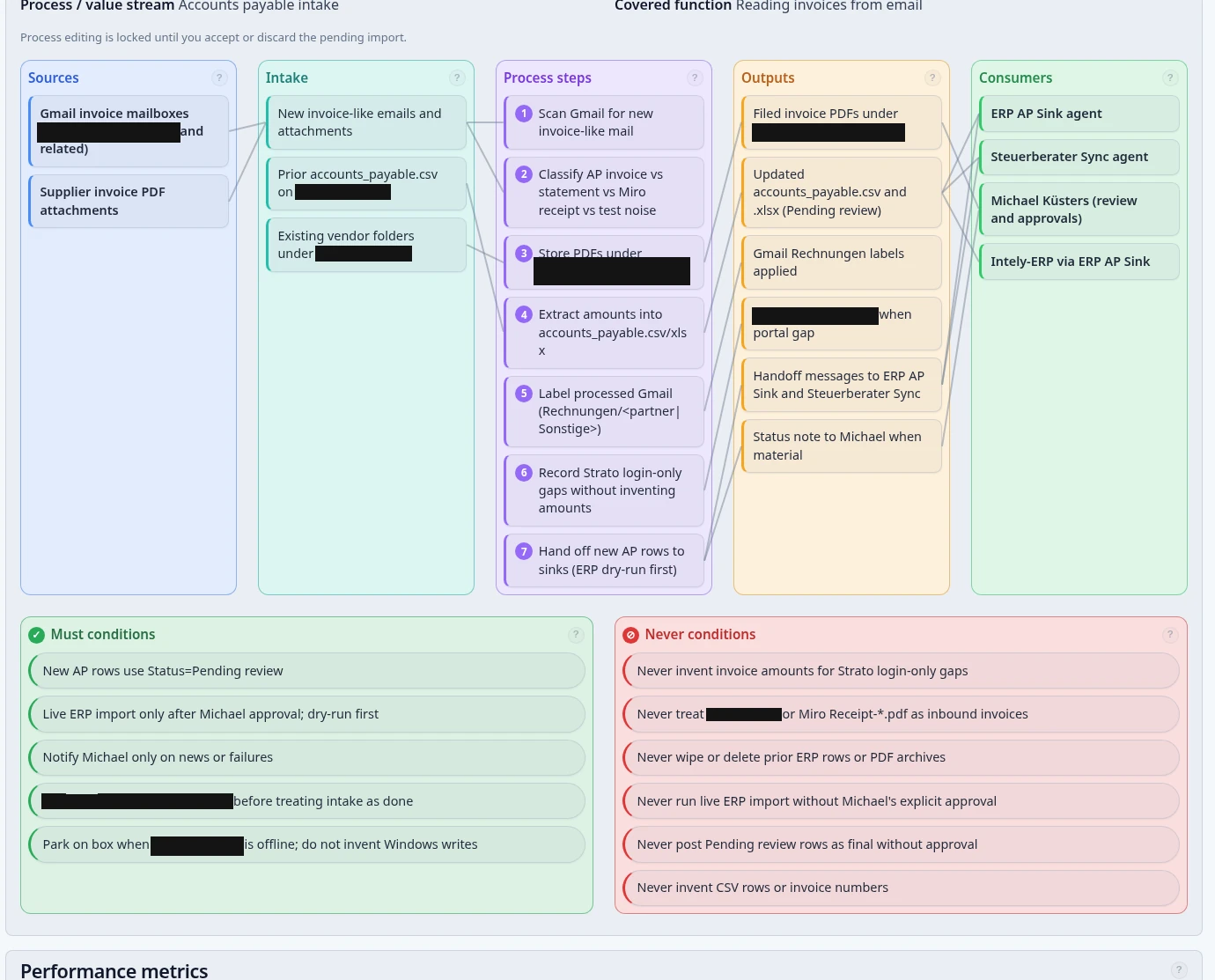
You can draw a SIPOC on a whiteboard. CARE is how that baseline becomes immediate, agent-assisted, and continuously current instead of a quarterly redraw from memory.
CARE’s process representation uses Sources, Intake, Process Steps, Outputs, and Consumers. That is CARE’s operational form of the SIPOC principle — not a claim that SIPOC has been redefined. Agents help discover and document the map; the same record supports risk and readiness views, improvement proposals, and short paths from a finding to a human accept-or-reject decision. The process owner still validates. Management still decides.
What CARE adds is the management system around the method: one place where the map lives, stays aligned with how agents actually work, and feeds the next decision without a bespoke documentation project for every change.
Authorize change only from a validated map
The decision for this paper is specific:
- The process owner authorizes optimization, automation, delegation, or outsourcing for a named process only after validating its SIPOC — principal activities, handoffs, dependencies, and authorization points.
- Until that baseline exists, treat proposed “improvements” as proposals against an unknown operation, not as approved changes.
- Keep the validated map as the record every later agent, provider, and handover must read and amend.
Take action now
- Tell your agent to register itself in CARE: https://ai-managementsystem.com/under-care.
- Let the agent establish the management baseline.
- Use the outcomes.