
Agent growth can multiply management effort

Building an agent is often inexpensive next to the labor it replaces. Identity, a permission conversation, a process note, a risk discussion, a change approval, and a recurring check are not. Those hours accumulate across teams, and they show up as delay: an agent nobody can describe is an agent nobody will trust with the work.
Fifty automations and a new administrative burden
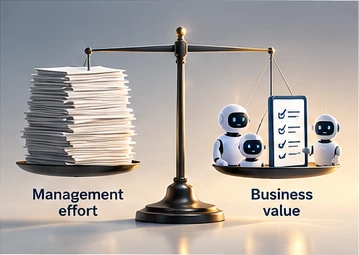
A company deploys fifty small automations, then assigns a specialist to interview each owner, maintain a spreadsheet, and chase an approval for every minor edit. The automations saved execution time. The specialist’s calendar is now the constraint.
The comparison that matters is total management effort: discovery, description, exception review, evidence, and the cost of an unseen risk. It is not the license line alone. A small firm that copies a large firm’s committee often ends up with no discipline at all, because nobody can sustain it. A large firm that lets every team invent the questionnaire pays for the same thinking fifty times.
Standardize preparation, reserve people for decisions
The executive who owns operational cost makes one change. Agents, or the people closest to them, prepare a fixed set of facts. A named owner validates and accepts. Experts see the exceptions.
- This week, time-box one agent that already runs. Write down the hours spent in the last change: who was interviewed, who redrafted, who waited. That number is your baseline, not a percentage borrowed from a vendor.
- Freeze the question set: purpose, owner, inputs, systems it can change, must-not-do, escalation, and what would reopen the decision. Refuse extra templates until this set has been used twice.
- Have the agent draft the answers from its own work. The owner corrects and accepts. Do not staff a fresh interview for a draft that only needs a correction.
- Route to a specialist only when the draft shows an unresolved exposure: money, personal data, an external commitment, or a contradiction. Log the hours. If they do not fall on the second agent, the question set is still too personal.
Count the management hours, then remove the repeated ones
Management stops being the bottleneck that makes each new agent a project. The people you kept are spending their time on the decisions that change exposure.
There is no universal saving to claim in advance. There is a design you can start today, and a number you can read after two agents. A shared management baseline makes the question set and the acceptance durable across teams. The economic test remains the hours and the exposures, which you can count without waiting for a business case.
Take action now
- Tell your agent to register itself in CARE: https://ai-managementsystem.com/under-care.
- Let the agent establish the management baseline.
- Use the outcomes.