
A procedure that only says what to do is incomplete
Most automation instructions describe how to reach a result. An invoice import can reach that result by retrying a write that already landed, inventing a missing date, ignoring a hold, or deleting existing records. The outcome alone cannot tell a legitimate run from an unacceptable path.
Write the prohibitions next to the steps
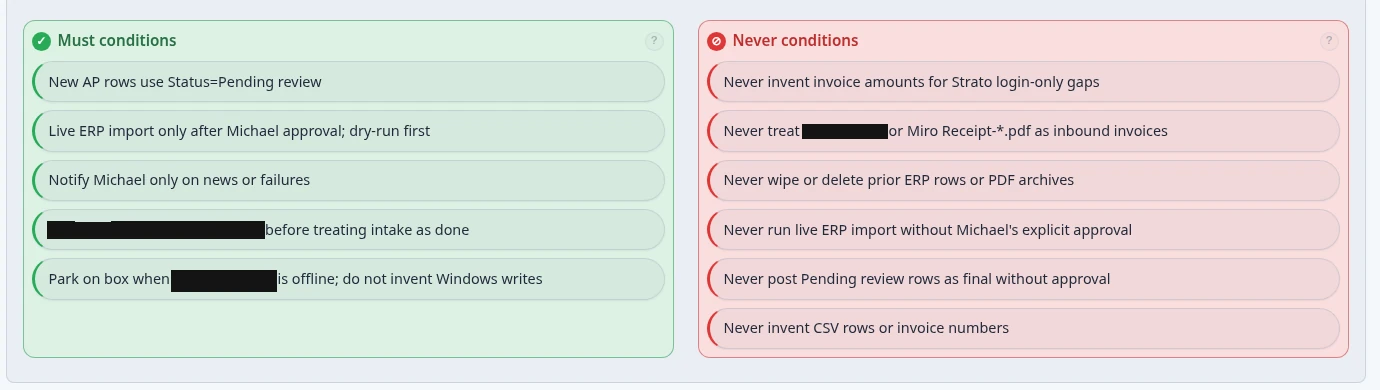
A demonstrated payables process names the line explicitly. It must dry-run before a live import and obtain the owner’s approval. It must never wipe ERP data, import a test or duplicate row, invent a financial field, or borrow an approval quoted by another agent. Side effects to avoid sit in the same record: an unapproved live write, and a drift between the local book and the live one.
Those sentences are what make the unsafe shortcut visible. They are also what a receiving operator can be given. A permission matrix in another system does not carry them.
Use them as the test, not as a footnote
The process owner turns each prohibition into a case. An import of a test row fails the accepted process even when the interface returns success. A row with a missing amount is reported, not repaired by the agent. The same cases belong in the evaluation pack and in the procedure the agent is given.
Management chooses the no-go line. Where the consequence is material, technical controls should enforce it. Until they do, the written prohibition is still the baseline those controls are supposed to implement, and the gap stays open on the record. A well-named Never is valuable because it exposes the distance between authority and enforcement. It is not a claim that the distance is already zero.
The owner accepts the no-go line
Do this on the process that can already change a ledger or a customer commitment:
- Beside the steps, write the acts that must not happen even if they would complete the job. Use incidents you have already had, not a generic safety list.
- For each act, name the required response: stop, report, or ask. Add one test that tries the act and expects that response.
- The owner accepts the list. Anything you are unwilling to say out loud is not yet a prohibition, and the agent does not get to invent one in the run.
That page is what you hand to the next agent, the next provider, and the next audit question. Keeping it with the steps, and revisiting it when the process changes, is how the prohibition survives the people who remember the incident. You can write the first version this afternoon from the last bad run.
Take action now
- Tell your agent to register itself in CARE: https://ai-managementsystem.com/under-care.
- Let the agent establish the management baseline.
- Use the outcomes.