
A supervisor agent also needs supervision

An orchestrator dispatches tasks, workers call tools, and another agent scores the output. The business sees one service. The operation is a chain of delegated capabilities. Adding the orchestrator feels like adding a manager. It adds another actor that can request actions it was never allowed to authorize.
Specialist agents hand work across boundaries
One agent coordinates specialists. It asks a second to summarize customer records and a third to send an action request. No single agent intended the combined outcome. Each step was inside its own instructions.
The failure mode is specific. The coordinator treats “send” as a task it may assign. The sender treats the assignment as authority. The customer receives a commitment nobody’s owner accepted. A second model that reviews the first can share the same missing fact and approve a fluent explanation.
In a demonstrated accounts-payable handoff, the outputs are named and the consumers are named: the ERP sink, the tax-adviser sync, and a human review. The map makes the boundary visible. It does not, by itself, decide who may widen it.
Write the delegation before you add the hierarchy
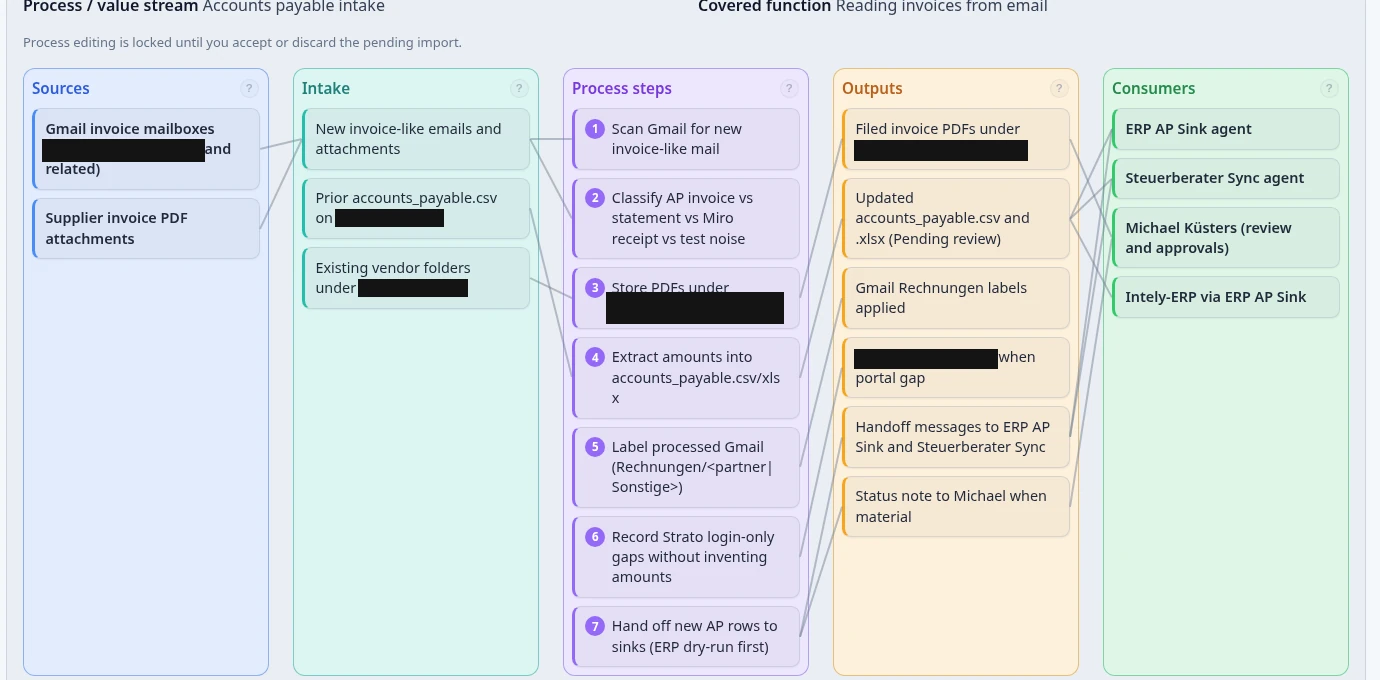
The owner of the business result — the person who would answer for the message, the record, or the payment — writes the delegation for one coordinated service before another supervisor is added.
- Name who may delegate, and the actions they may request. “Coordinate the case” is not a list.
- Name what cannot be relaxed by the coordinator: prohibited acts, data that must not move, and any external commitment.
- Name who accepts the result that leaves the company. A worker agent does not inherit that acceptance by being asked.
- If a reviewer agent is in the chain, give it evidence the actor did not write: the system record, or a human decision. A paraphrase of the actor is not a review.
Human authority sits on the external result
You can run a network of agents at the speed of the work, because the authority question was answered once, at the boundary, and is reused.
The result you can show today is one page for one service: delegator, prohibited relaxations, and the human who accepts the external effect. Where a cell is blank, that action does not run. Repeat the page when a new worker is added. Oversight stays practical because you are not re-deciding every handoff, and you are not pretending the transcript of the swarm is the management record.
Take action now
- Tell your agent to register itself in CARE: https://ai-managementsystem.com/under-care.
- Let the agent establish the management baseline.
- Use the outcomes.