
A failed response is not always a failed transaction
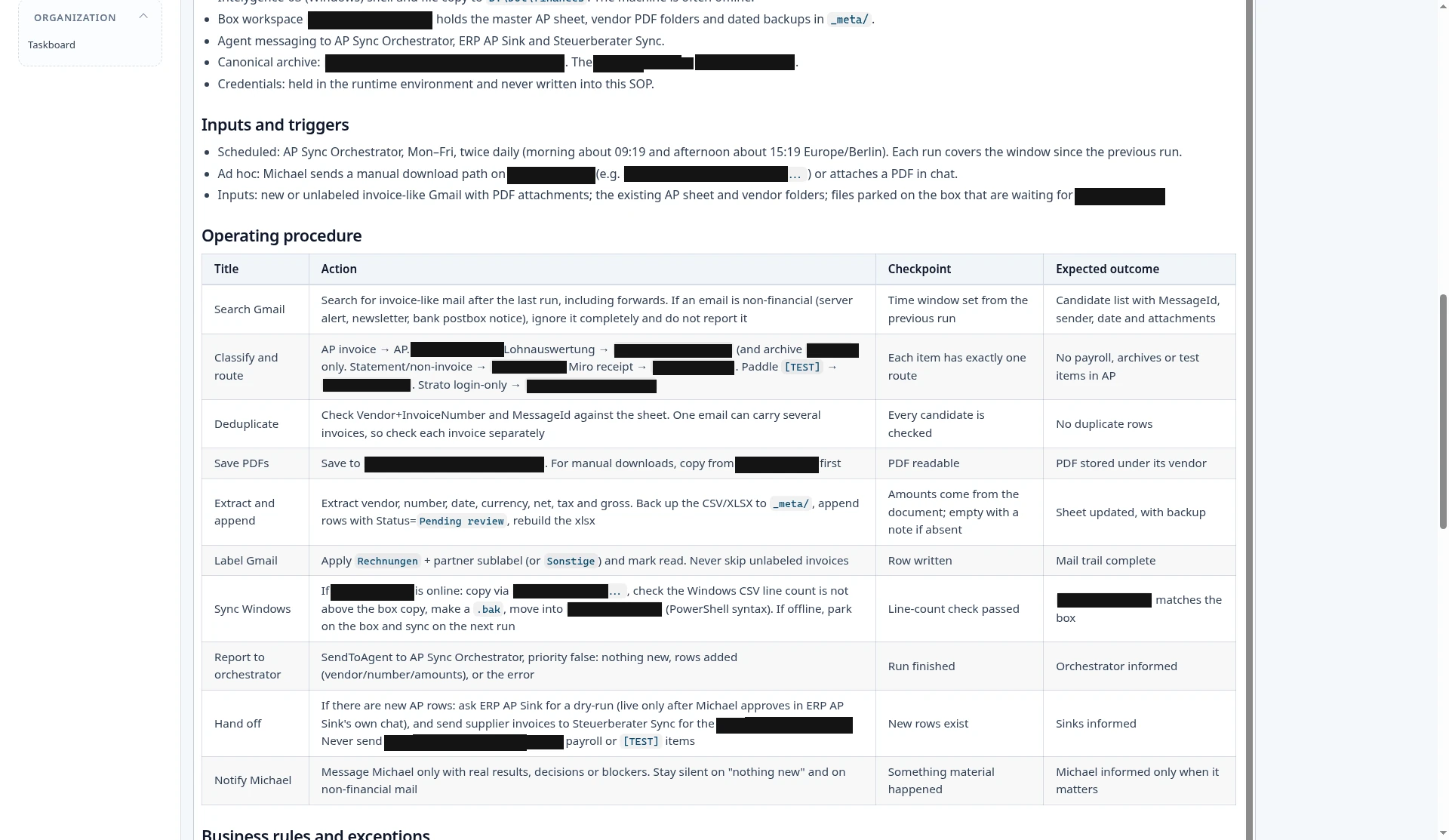
In a documented invoice workflow, the import can return HTTP 500 after writing the records. An agent trained on ordinary interfaces will retry a failure. Here the retry is how duplicate financial entries are born. The status code described the call. It did not describe the ledger.
The correct response is to look
The operating rule recorded for that workflow is specific. After the import’s HTTP 500, verify by reading the records back. Do not retry. Idempotency keys and a confirmation that the approved rows exist once in each ERP environment are part of the same response. The observable outcome outranks the superficial label.
That is an accepted interim behavior where it has been written into the procedure and the run follows it. It is not a claim that every integration lies, and it is not a claim that duplicates are now impossible.
The same failure is a process, an accounting, and a handover fact
What begins as an API irregularity becomes a process rule, an accounting concern, and a fact the next operator must know. A replacement team needs the endpoint behavior, the verification method, and the action when the two environments disagree. A provider who has not been told will rediscover it by posting twice.
The same procedure still leaves gaps that should stay visible: a fully documented reversal of a wrong import, and an automated comparison of the two books, are not yet established. The useful deliverable is a precise failure with an accepted interim response and an explicit backlog. It is not a claim of an error-proof import.
Accept the interim response and the open reversal
The process owner does this for any interface that can change a ledger and has ever disagreed with itself:
- Write the observed lie in one sentence: which call, which status, what the ledger actually contained afterwards.
- Set the interim response: read the records, do not retry, confirm the approved items exist once. Put it in the procedure the agent is given.
- Name the open remainder — reversal, automated parity, or both — with an owner. Do not describe the import as reliable beyond the interim response.
You have removed a class of duplicate postings without a platform replacement. The management record keeps the rule next to the steps so it survives the person who watched the first 500. The decision to accept that interim, and to leave reversal open, is the owner’s, and it can be made as soon as one bad response has been seen.
Take action now
- Tell your agent to register itself in CARE: https://ai-managementsystem.com/under-care.
- Let the agent establish the management baseline.
- Use the outcomes.