
The agent should not invent a hierarchy
In a demonstrated payables case, a direct hold from the owner conflicted with a relayed request to import. The run that treats the later or the more convenient instruction as the winner has chosen a hierarchy. Nobody accepted that hierarchy. The agent discovered it under time pressure, which is the worst moment to discover it.
State the stop in the words of the conflict
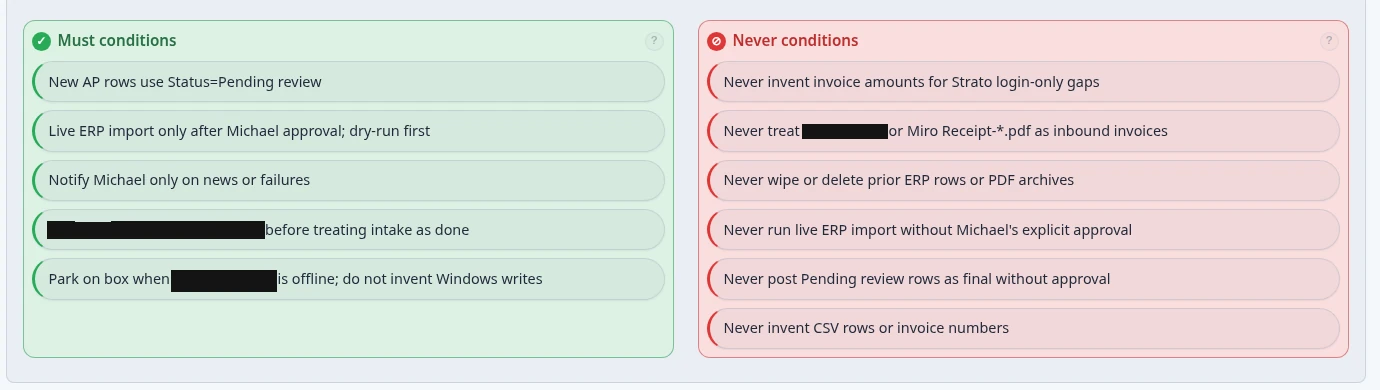
The action proposed for that process is concrete. When the owner’s direct message conflicts with a relayed instruction, the importing agent stops and asks which applies. A Never condition already says that approval quoted by another bot is not owner approval. Together they convert a conversational tangle into a boundary an operator can follow and a tester can provoke.
Write your version from your own conflict, not from a generic “if unsure.” The trigger should be recognizable: these two message types, these two parties, this consequential act.
Escalation is a step with a recipient and a held state
A useful step names the trigger, the recipient, and the evidence that travels with the question. It also says what remains on hold, and whether other work that does not conflict may continue. Without the held state, escalation is a sentence that collapses when the queue is long and nobody has replied. “Ask the owner” fails when the owner field is empty or the workflow proceeds by default.
Make the hierarchy testable
The process owner publishes the hierarchy for one workflow and proves the agent obeys it:
- Name which instruction wins, and which pairs of instructions are a conflict rather than a sequence. In the payables case, a direct hold wins over a relayed import until the owner resolves it.
- Write the stop: no live write while the conflict is open, who is asked, and what they must be shown.
- Run contradictory messages. The pass is that the consequential act did not happen, and that the question landed on the named person. Keep the transcript. It is evidence for these conditions, not a universal guarantee.
The accepted definition is where that winner lives, and where a later change to it is visible. The owner remains the person who may change the hierarchy. The agent remains the party who must not.
Take action now
- Tell your agent to register itself in CARE: https://ai-managementsystem.com/under-care.
- Let the agent establish the management baseline.
- Use the outcomes.