
Documentation usually arrives after the operation exists
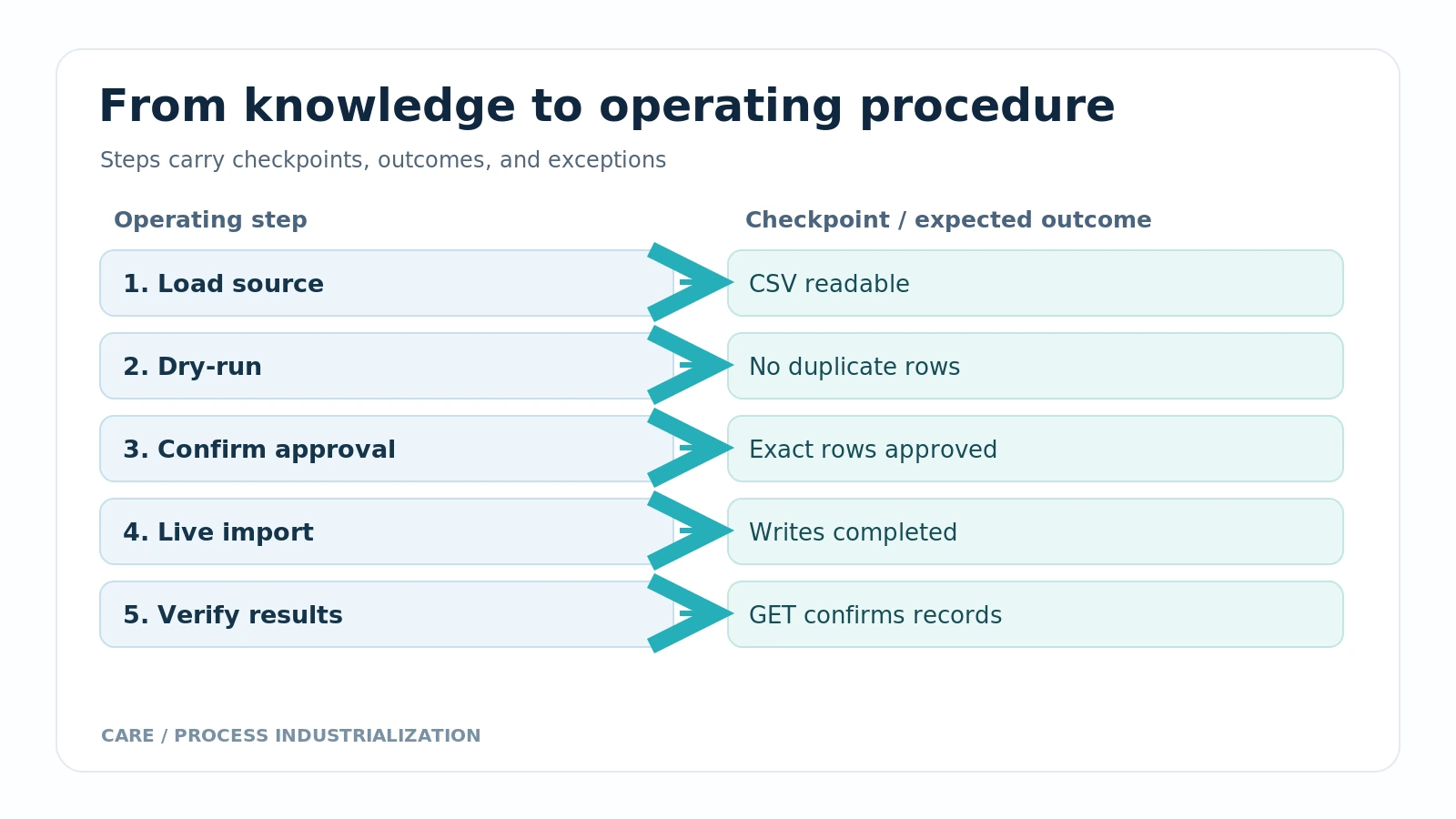
“Import approved invoices” is not a procedure when the endpoint sometimes returns HTTP 500 after a successful write. The detail that makes the run repeatable was learned in production, then left in the head of whoever handled it. A later writing exercise produces a document too vague to reproduce the difficult hour.
A usable procedure names the checkpoint and the exception
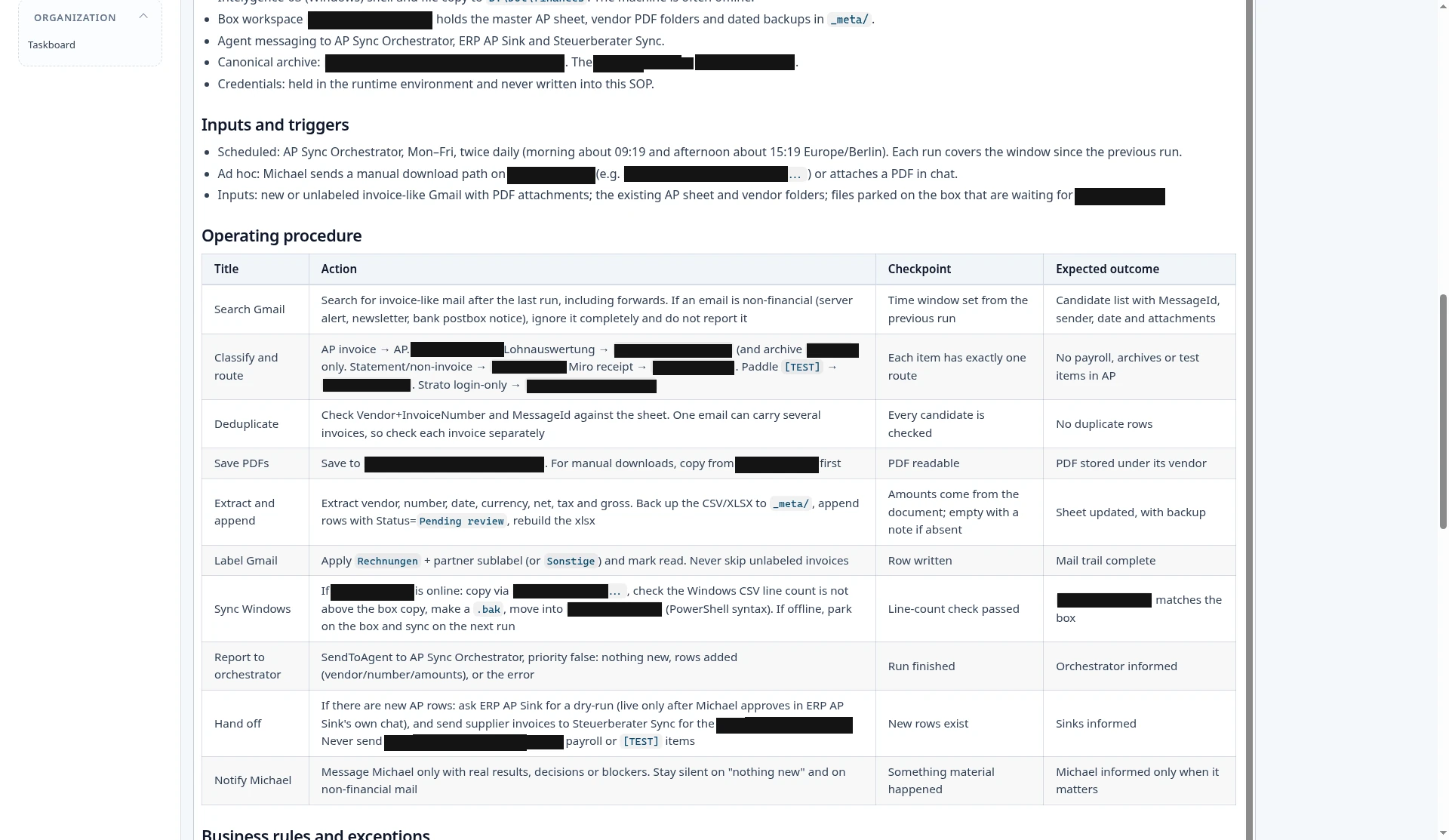
A demonstrated payables procedure identifies the trigger, the sheet, and the approval input. The step table carries a title, an action, a checkpoint, and an expected outcome. A dry-run hits local and live systems. Exact rows go for approval. Approved rows are imported. Each result is verified by reading it back, rather than by retrying a misleading failure. Supplier and expense links are produced before the final report.
The same draft records missing dates or amounts, duplicate identifiers, a hold from the owner, a machine that is unavailable, and conflicting instructions. Those lines matter more to a receiving operator than a diagram of an ideal day. The draft also says what is unresolved, including how to undo a wrong import. Existence of the document is not proof that the undo exists.
The owner accepts the draft, including what it cannot yet do
The process owner compares the draft to a recent run and to the incidents they remember. They strike steps that describe a wished-for system. They keep gaps labeled as gaps. They accept the rest as the procedure the next operator, human or agent, must follow. A later change to the run updates the draft and waits for acceptance again. The procedure stops being a writing project that trails the operation by a quarter.
What a receiving operator can rehearse
Do this for one process you would be afraid to hand to a colleague on Monday:
- Ask the performer for a step table: action, the state that proves the action happened, and the expected records. Demand the API method or the equivalent concrete act, not a verb like “process.”
- Demand one failure path per known lie or outage: what to do, or an explicit “not yet defined.”
- Rehearse one ordinary run and one failure from the table. Accept the table only if a person who did not build the automation can follow it. Leave every unrehearsed gap open.
Management is no longer the bottleneck that delays handover until a technical writer is free. The performer already has the knowledge. The owner spends their time on acceptance and on the gaps, which is the decision the organization actually needed.
Take action now
- Tell your agent to register itself in CARE: https://ai-managementsystem.com/under-care.
- Let the agent establish the management baseline.
- Use the outcomes.