
All the checks can be green

An agent is authorized to read customer data, summarize trends, prepare an internal report, and store it in an approved workspace. No access violation is recorded. The workspace is broadly readable. The report makes personal information available to people who were never the audience for the source records.
This is an illustrative path, not a reported customer incident. It is the failure mode to assess: the process, not a sequence of isolated calls.
Look at the path, not the calls
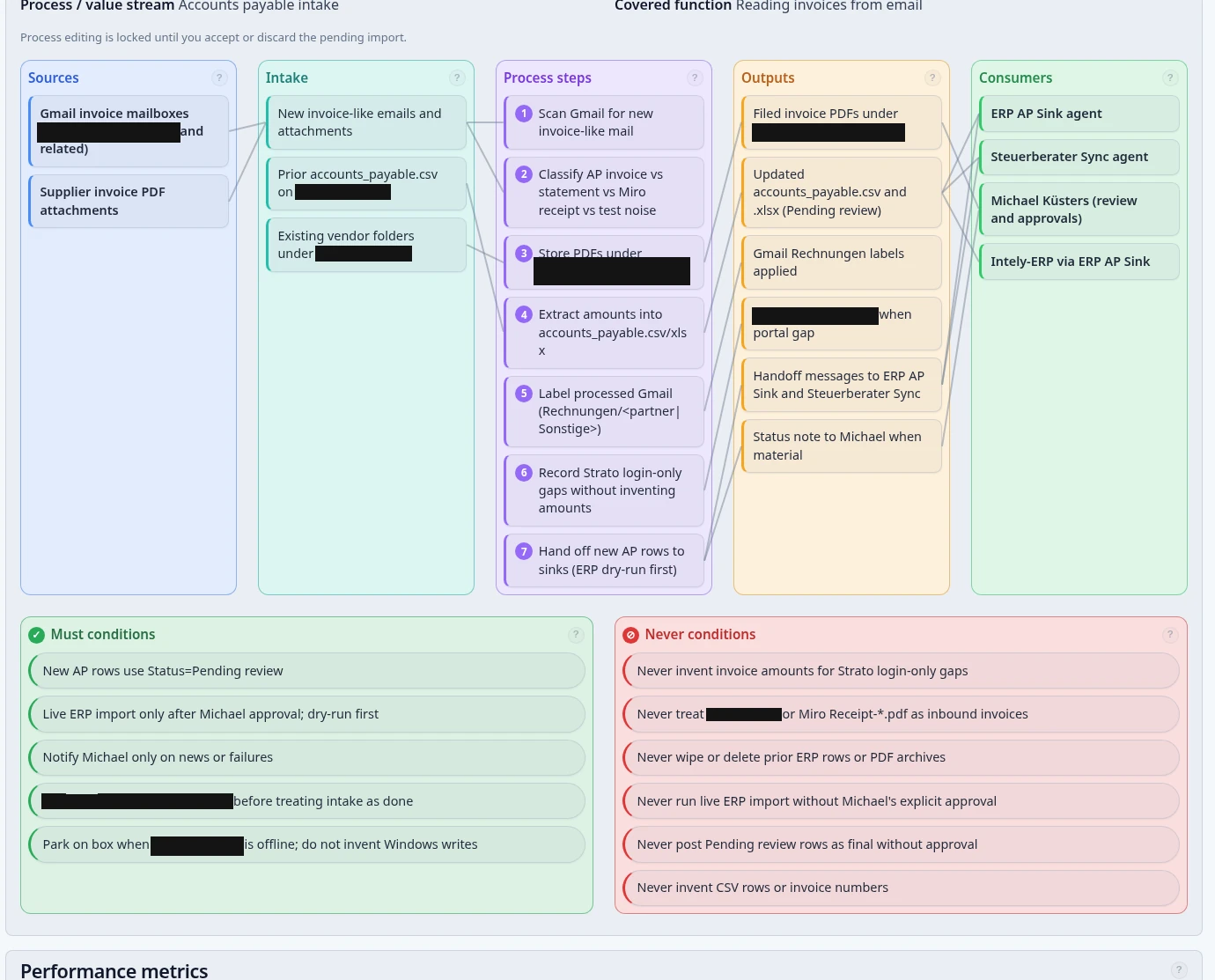
The review that catches this asks who can open the final output, whether personal data is still identifiable, whether the storage location inherits a wider permission, and whether a person is required before the output moves again. A demonstrated payables stream makes the same structure discussable: sources, steps, outputs, consumers, and the conditions that must hold. The structure is what you copy. The payables content is not your incident.
The owner changes the arrangement or accepts the exposure
The business owner of the report — not the owner of each tool — decides. Removing the tool is one option. It is often the wrong one.
- Draw the path for one agent that assembles information and stores or sends it: sources, steps, output, who consumes it.
- Mark the step where sensitivity increases. In the example, that step is the combined report in a shared place, not the original read.
- Choose a change: a narrower audience, redaction, a restricted location, or a person before external sharing. Or record that the residual exposure is accepted, by name, with the reason.
- If the change is a rule on paper only, label it as not yet a barrier. Assign the person who can implement it in the system that stores or sends the output.
Obedience is not the same as an acceptable process
You keep the useful agent. You stop treating a clean permission log as evidence that the operating arrangement is one you meant.
The result is one path diagram and one decision. The same review applies the next time a redesign changes a consumer without adding a tool — a common way a safe sequence becomes an unsafe one. Management attention moves to the arrangement, which is where the authority to change it already sits.
Take action now
- Tell your agent to register itself in CARE: https://ai-managementsystem.com/under-care.
- Let the agent establish the management baseline.
- Use the outcomes.