
An agent with a job, but no manager

A customer-support agent answers common questions, reads account details, and escalates unusual cases. The team treats it as settled because the answers are useful. Asked who may change its allowed tasks, the team offers three names. The absence of a decision shows up later, when a change or a dispute arrives and each name declines.
An owner is a decision, not a nearby name
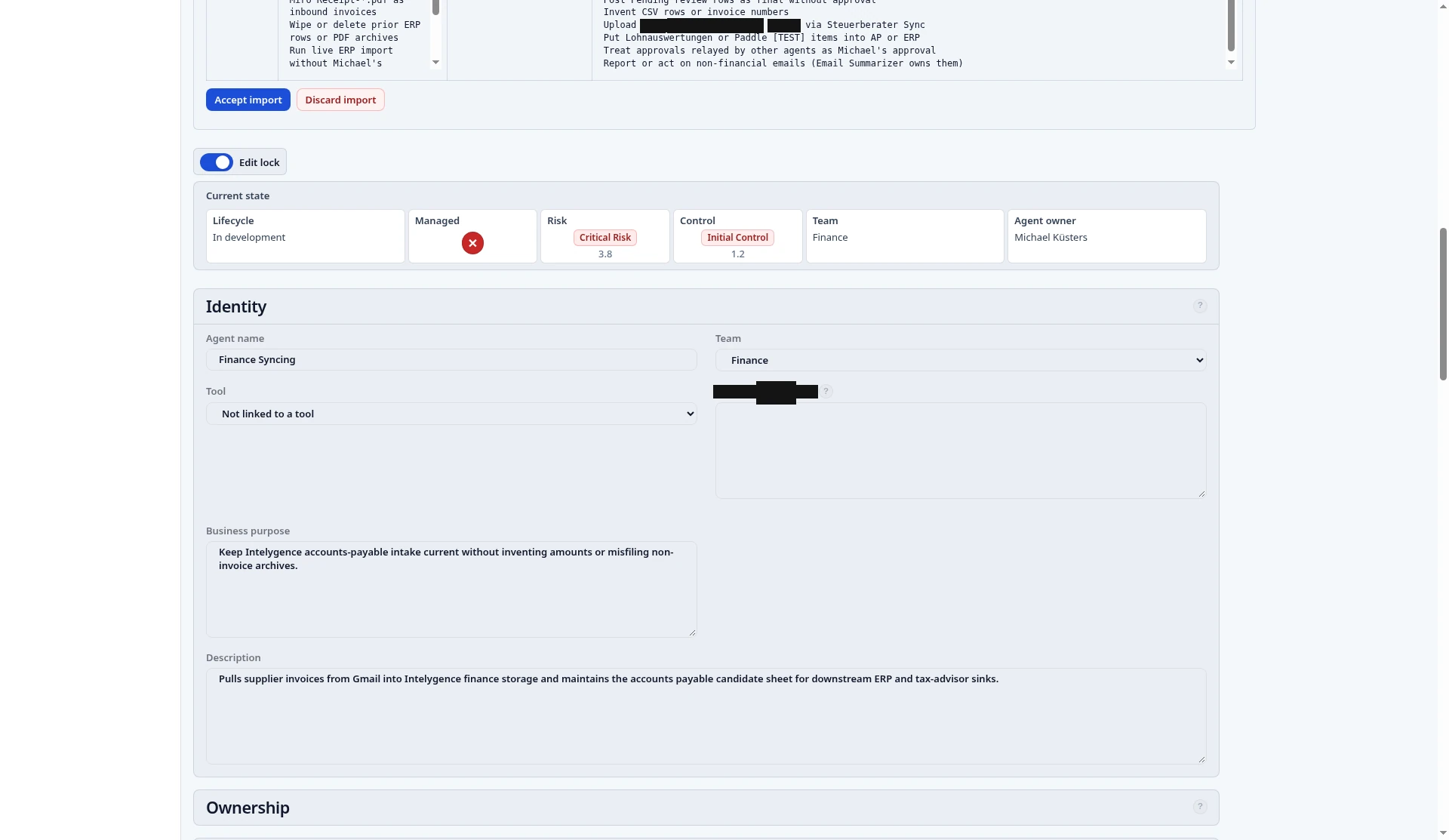
Department leadership, operations, and risk can each hold a piece. The missing decision is which person may authorize this operating model, and which person responds when the agent reaches a boundary. A name in an inventory, unknown to its bearer, is not that decision. A shared mailbox with no duty to answer is not that decision either.
The head of the function that benefits from the agent makes the appointment. They choose someone who can be reached and who can refuse a wider role. They tell that person, and they tell the team.
What the owner is then able to decide
Do this for the support agent, or for whichever agent in your firm currently has three candidate bosses:
- Appoint one owner. Say it in a sentence the team can repeat.
- Have the owner accept, in writing, what the agent may do, where it must stop, which exceptions come to them, and which technical controls someone else must still provide.
- Route the next boundary event to that person: a new tool, a sensitive customer, a proposed wider role. Ordinary answers do not wait for them.
Uncertainty gets a destination
The agent keeps its speed on the common path. The uncommon path has a person who is obliged to decide, and who knows it.
The result is one appointment and one accepted boundary. The next dispute does not begin with a search for who was vaguely responsible. That is the management system at the smallest scale that still works: a living record of owner and boundary, updated when the role changes, readable by the people who run the agent.
Take action now
- Tell your agent to register itself in CARE: https://ai-managementsystem.com/under-care.
- Let the agent establish the management baseline.
- Use the outcomes.