
An agent that never stops is not finished
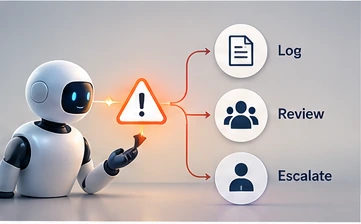
Most operating notes describe the happy path. Inputs arrive, the agent acts, an output follows. The runs that cost money are the other ones: a missing fact, two instructions that disagree, a tool that reports failure after it has already written, a consequence outside the original ask.
In those runs an agent with no stop condition improvises. Improvisation is a decision. It is simply a decision nobody accepted in advance.
Conflicting instructions reveal a missing stop
An owner places an invoice on hold. A coordinating agent sends a handoff that says import. Both messages look operational. In a demonstrated accounts-payable case, following the later message imported a row the owner had held.
The same shape appears when the agent has no named owner and is told both to disclose and to withhold. Continuing with a guess is the unmanaged choice. “Ask the owner” is incomplete when the owner field is blank, or when the workflow proceeds because nobody replied.
Write the stop, the recipient, and the safe state
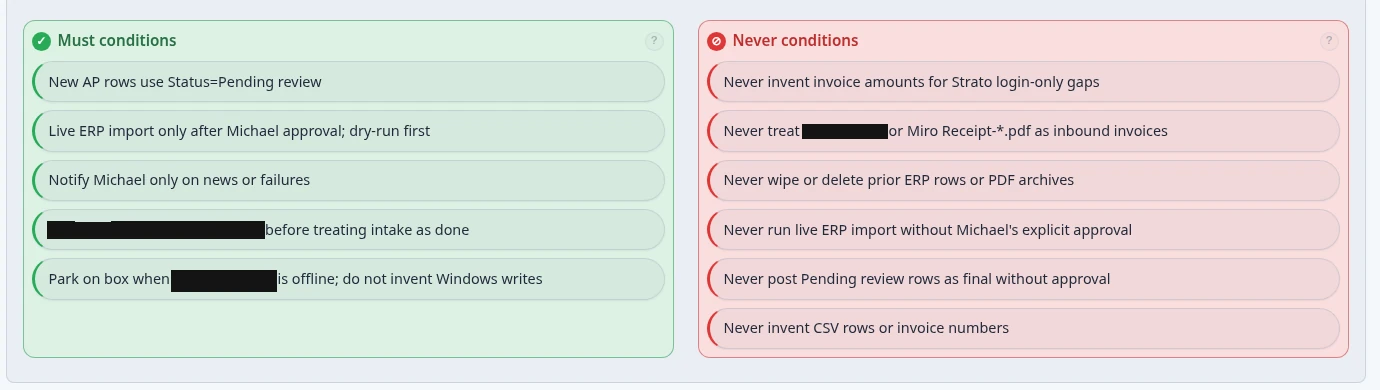
The process owner writes the stop for one consequential workflow. Required outcomes and prohibited acts belong in the same note. So does escalation: the trigger, the person who decides, the information that must travel with the pause, and the state of the work while you wait.
- Pick the workflow that already improvised once. Write the trigger in the words of that incident, not as “if unsure.”
- Name a reachable person. A role with no incumbent is not a destination.
- State the safe state: what stays unsent, unposted, or unimported until that person answers, and which unrelated work may continue.
- Run one contradictory pair of instructions and keep the transcript. The pass condition is that the consequential act did not happen.
A correct stop is a successful run
You can let the agent run the ordinary path at full speed, because the extraordinary path has a destination other than the agent’s judgment.
The result is a one-page stop rule and a passed contradiction test. Teams stop scoring every refusal as friction. The next incident of this type has an owner and a held transaction, instead of a committed one and a reconstruction. As more agents share the workflow, the same stop is the rule they all inherit.
Take action now
- Tell your agent to register itself in CARE: https://ai-managementsystem.com/under-care.
- Let the agent establish the management baseline.
- Use the outcomes.