
Agents move; accountability must remain

A host platform can inspect the agents it runs. It does not see the assistant in a competing service, the local automation, or the broker that coordinates workers across providers. When the runtime changes, a record that lived only in the old console changes with it — including who was accountable and what they had forbidden.
Three platforms, three partial inventories
Marketing runs agents in one service, engineering in another, and finance uses an assistant inside the ERP. Each console has a different idea of what “managed” means. Each team believes its list is the list.
A model swap or a vendor change then silently rewrites the business authorization, because the authorization was whatever the console happened to store. Nobody decided to change the authority. The authority moved because the record did.
Separate the management record from the runtime
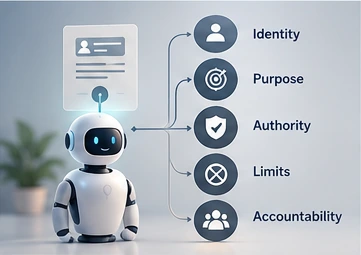
The person who owns enterprise accountability — often the COO or the process owner for a single function, if that is as far as you can reach today — requires one organizational record per acting agent. The execution platform is an attribute of that record. It is not the authority of it.
- Pick two agents that do not share a vendor. For each, write on one page: identity, purpose, human owner, process, constraints, dependencies, permissions, and the last accepted change.
- Mark every fact you could not state without opening the vendor console, and every fact you could not state at all. Blanks stay blanks.
- Decide which of those facts must remain true if the vendor is replaced next quarter. Those facts are the management record. The rest may stay in the platform.
- Where an agent cannot present itself, a person or a synchronizing job collects the facts. Collection is not acceptance. The owner still accepts.
Portability is a management requirement
You can change a model or a host without reopening, by accident, the question of who is accountable and what is forbidden.
The result is two comparable pages and a short list of facts that must survive the vendor. That list is the requirement you give to any management system, any integrator, and any future platform. Teams keep the tools that already deliver value. They stop treating three partial inventories as oversight.
Take action now
- Tell your agent to register itself in CARE: https://ai-managementsystem.com/under-care.
- Let the agent establish the management baseline.
- Use the outcomes.