
Agents are already an operating workforce

Companies know how to place an owner on an employee, an application, and a process. Agents sit between those categories. An employee creates one. A platform hosts another. A product arrives with a third already inside. It can run for months. It can change a customer commitment or a ledger line while the person who requested the experiment has moved on.
The questions that then go unanswered are operational, not theoretical. Which agents are acting, and at what? Who answers for the outcome? What may they do, and what must they never do? Which systems can they change? What happens to those answers when the tool or the instruction changes?
Existing systems each answer a different question
Security policy, identity, software inventory, and a deployment-time risk assessment remain necessary. None of them is the management of the agent. Identity can show which credential was used and still say nothing about whether the activity was an acceptable business act. An application inventory can name the host and still omit the responsibility and the escalation. A risk assessment written at launch does not follow a later change of tools.
The practical result is a split brain. The organization knows the technology and not the duty. It knows who created the agent and not who accepts its decisions. It has controls on access and no routine for accepting a change to authority. Each new agent then becomes a small project — interview, spreadsheet, meeting — or it becomes invisible. Both outcomes spend the benefit the agent was adopted to create.
One record, a human acceptance, a revision when it changes

Industrial management of agents is a repeatable cycle, not a framework document.
Establish. Every acting agent gets a record a manager can read: purpose, owner, what triggers it, what it may change, what it must not do, and where it escalates. The agent, a person guiding it, a synchronizing job, or a manual entry can prepare the draft. Preparation is not acceptance. Unknowns stay visible. A friendly name that hides a financial write is corrected before the record is accepted.
Accept. The owner accepts the boundary. A later proposal — a wider job, a new tool, a new recipient — is staged beside the accepted record. The owner sees the difference and accepts, narrows, or refuses. Ordinary work inside the boundary does not wait for a meeting. A change to purpose, authority, prohibitions, data exposure, or external effect does.
Revise from the work. The performer is the first to meet the exception, the misleading status, and the dependency. Those become findings and proposed changes, cited to a run. The owner decides. Assurance follows the change: a new permission or a lost owner reopens the decision. A calendar reminder does not substitute for that, and a report that nobody looked is not a clean bill of health.
The same record is what you hand to a new provider, compare across platforms, and test against. A transcript of the agent is not the record of what was authorized. The ledger is not the record of what was allowed. You keep all three, for the questions they actually answer.
What the organization does differently on Monday
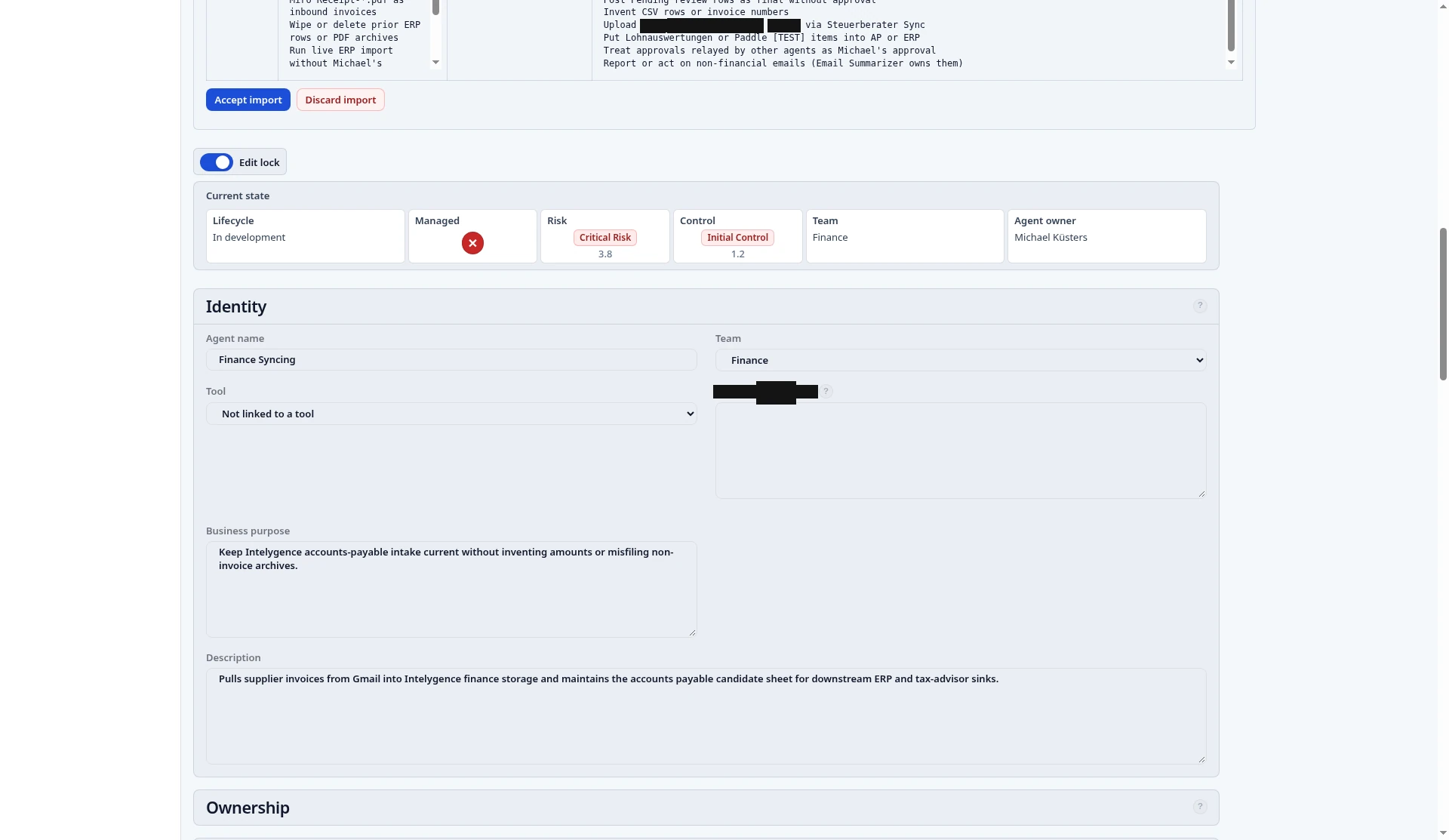
The chief operating owner — the COO, or the head of the function if that is the honest reach — stops treating agent management as a future program and puts the cycle on the agents that can already hurt the business.
- List the agents that contact customers, move money, or change a record people trust, including the ones that are not in the model catalog. Name an owner for each. If you cannot, that agent does not gain new access.
- Have each one prepared by the path that fits: its own draft, a supervised draft, a description taken from the host, or a page written by hand. The owner accepts a boundary: purpose, must-not-do, escalation. One page is enough.
- For the next proposed change of authority, stage it and time the decision. Inside the boundary, let the work run. On the first real exception, ask the performer for a finding and decide it. Do not open a documentation project.
Management stops being the queue
Agents keep the speed you adopted them for. Management keeps the decisions that change what the business becomes, and those decisions get shorter because the record, the difference, and the owner already exist.
That is the operating capability: immediate enough to start without a transformation, transparent enough to see what is acting and what is undecided, short enough that a finding becomes a decision, and current enough that a changed agent is not still covered by last year’s acceptance. It improves the work, because exceptions become the next change instead of folklore. It still scales, because the questions do not get reinvented per agent.
Nothing in the cycle requires you to buy a tool before Monday. A management baseline is how the cycle remains one system as the number of agents grows, instead of a stack of pages with no acceptance trail. The pages, the owners, and the refusals are the management act. They are available now.
Take action now
- Tell your agent to register itself in CARE: https://ai-managementsystem.com/under-care.
- Let the agent establish the management baseline.
- Use the outcomes.