
An obedient agent can still be dangerous

Reviews ask whether an agent exceeded its access. That question matters, and it misses the risks created by the work that was authorized. An agent allowed to edit a financial record can stay inside its rights and still collapse segregation of duties, or post a material change with no independent approval.
When an innocent name hides financial authority
An ERP agent has legitimate write access and follows its instructions. The process never established an independent approval for material changes. In a worked reassessment, describing that agent by the financial work it actually did moved the arrangement to the highest risk category. The agent could propose an approval gate. Accepting the gate belonged to a person. Nothing in that episode shows that agents in general will find or fix their own hazards.
Ask what a successful authorized action can do: alter a financial record, expose customer information, make an employment decision, or publish a claim. Ask who can reverse it, and whether a second person sees it before it sticks.
Accept the operating model, not only the permission
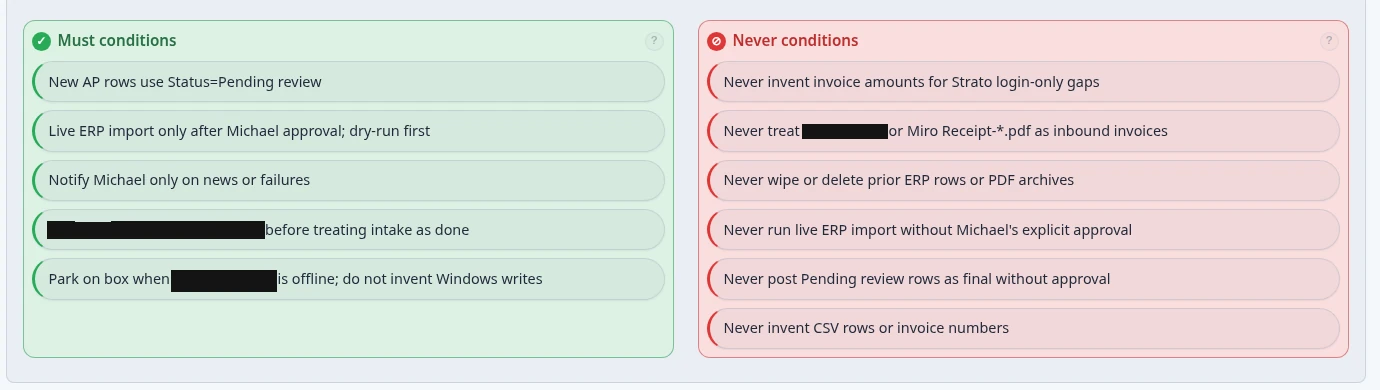
The process owner, who is the risk owner, accepts or refuses the arrangement. A permission review can feed that decision. It cannot replace it.
- Choose one agent whose access is easier to describe than its effect. Write the effect in one sentence: which record, which external party, whether it is reversible.
- Write the control the effect requires: a second person, a prohibition, a stop, a limit. If the control is absent, the arrangement is unaccepted, even though every log line is clean.
- Accept the residual risk explicitly, or change the arrangement and assign the person who will implement the control where the effect actually happens.
The owner of the process owns the risk
Obedient agents remain an asset. The hazard you remove is the one that was designed in and then certified by a permission check.
The result is one accepted operating model, or a stopped one, with the control named. Repeat it for the next agent that can change a record people trust. A baseline that holds the definition and the acceptance together keeps the decision readable when the team changes. The decision is available now, from the access you have already granted.
Take action now
- Tell your agent to register itself in CARE: https://ai-managementsystem.com/under-care.
- Let the agent establish the management baseline.
- Use the outcomes.