
The rule was in the incident, not in the runbook
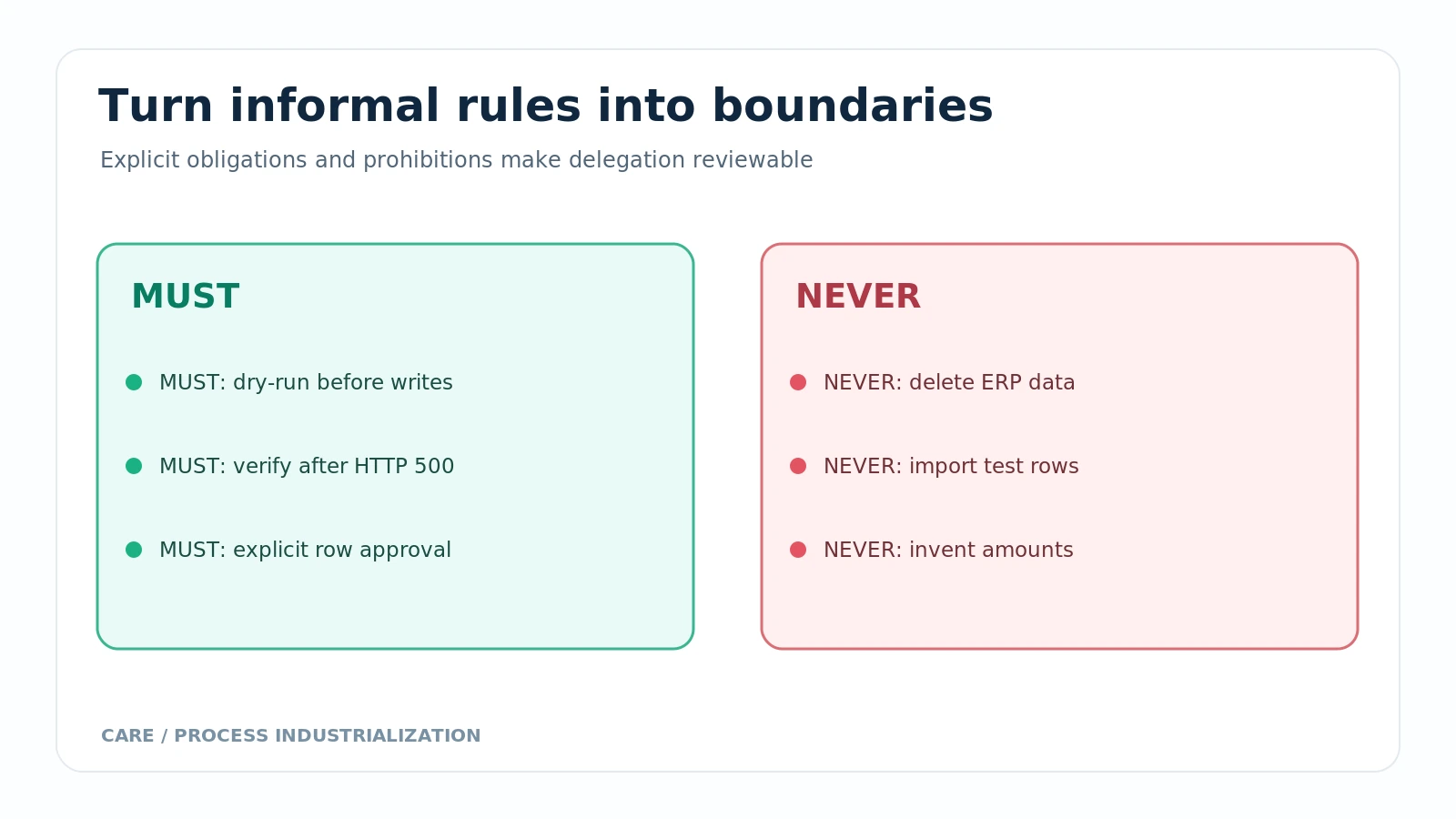
“Do not import until I approve the named rows in this chat” is the kind of sentence that appears while something is already wrong. It can become the financial control. It remains invisible to the next operator, the next agent, and any team you hand the work to.
Must and Never do different jobs
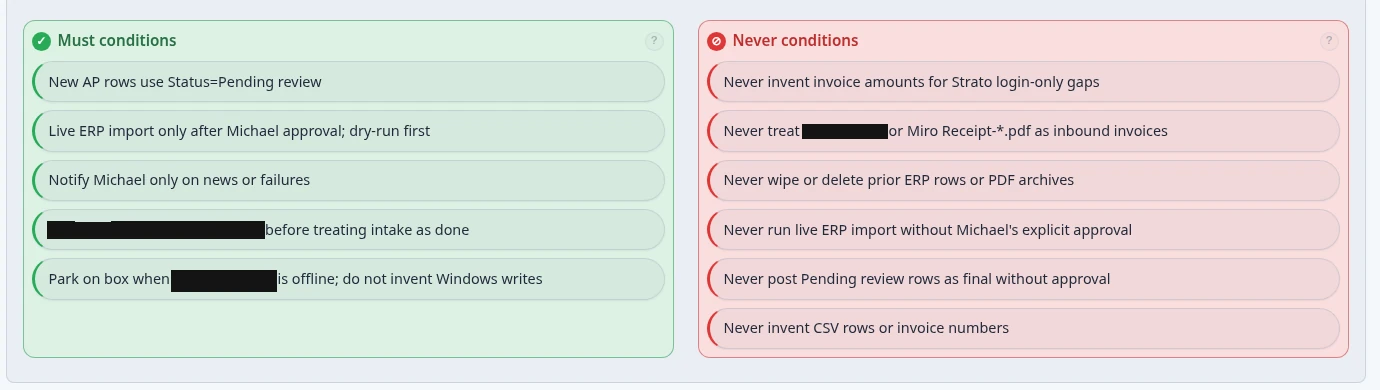
A demonstrated payables definition records both. Must: dry-run first, obtain the owner’s approval of named rows, dual-write until cut-over, use an idempotency key, and verify by reading the records back after an HTTP 500. Never: wipe ERP data, import test rows, invent amounts or dates, or treat an approval quoted by another bot as the owner’s approval.
A Must pushes the run toward a safeguard. A Never draws the edge of authority. The distinction matters when the task can be completed in several technically successful ways, only some of which are allowed. Reviewed next to the steps, the conditions tell an operator which success is acceptable.
Transfer the rule, then decide it is the rule
The owner still has to decide that the harvested sentences are the policy, not a recollection. Once accepted, they are the basis for training, evaluation, change, and handover. A written rule does not replace a technical block. Where the consequence is material, the system that performs the write should enforce the boundary as well. Until it does, say that the enforcement is open.
- Pull the last incident thread for one consequential process. Extract every instruction that changed what was allowed.
- Rewrite each as a Must or a Never, in the procedure, with the response: stop, verify, or ask. Name whose approval counts, and in which channel.
- The owner accepts or strikes each line. Add one test: a missing amount is reported, not invented; a relayed “yes” does not import.
What the owner can point to afterwards
| Recovered rule | It is real when |
|---|---|
| Who may approve | The channel and the person are named; a quoted approval from another agent does not count |
| What counts as approval | The object is specific — these rows — and a vague reply returns to a person |
| What may not be invented | A missing amount or date is reported, and a test tries to make the agent invent one |
You have removed the dependency on whoever remembers the incident. The same conditions travel with the process when you automate further or hand it to a provider. That is a management record doing its job: the rule is available, the decision is attributable, and the next change has something precise to amend.
Take action now
- Tell your agent to register itself in CARE: https://ai-managementsystem.com/under-care.
- Let the agent establish the management baseline.
- Use the outcomes.