
An agent transcript is not a transaction ledger
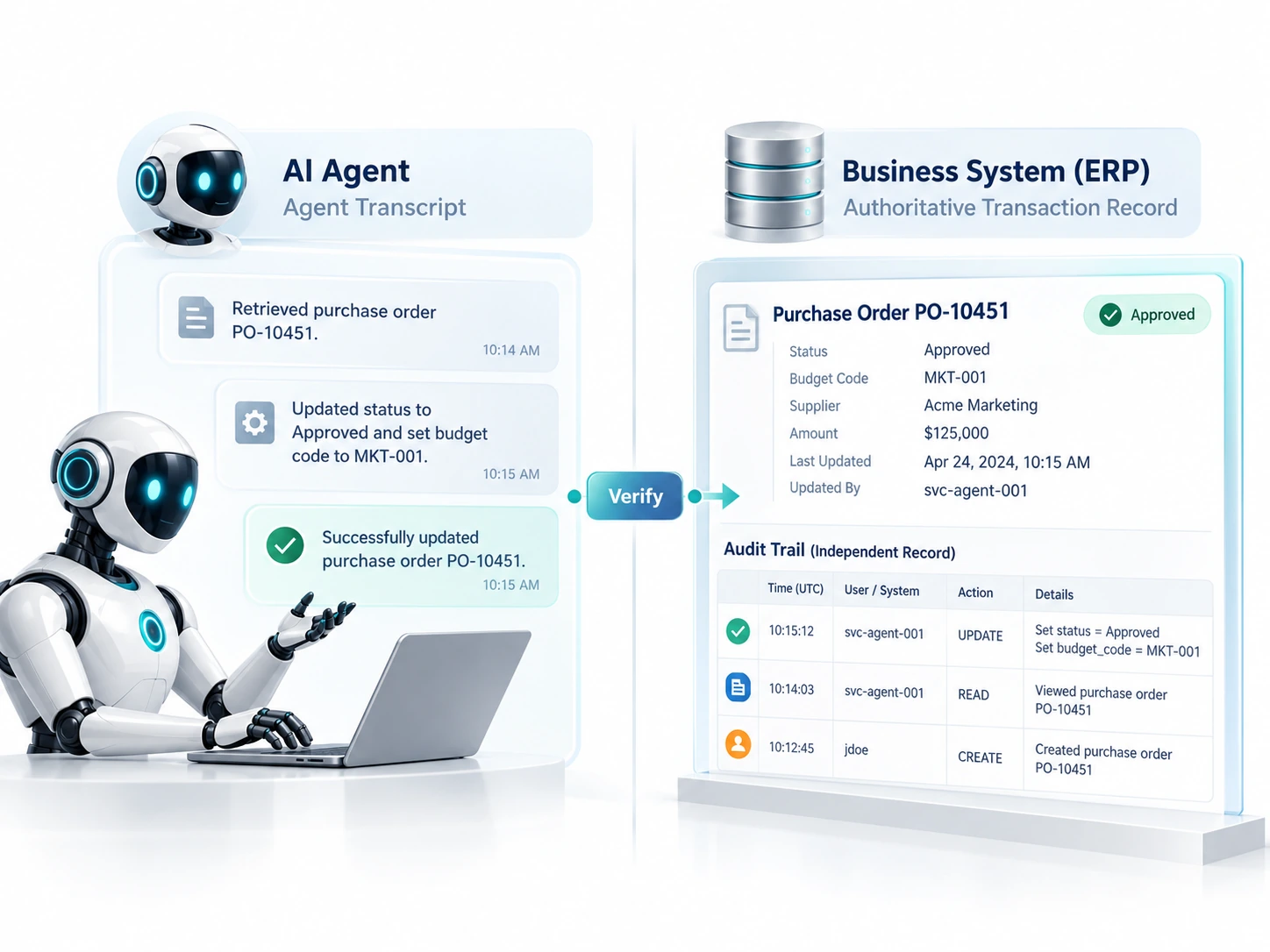
After an agent touches money, a customer record, or a regulated outcome, the organization often keeps the conversation. The conversation is the agent’s account of messages, tool calls, and reasons. It can omit a call. It can describe a write that the target system refused, or skip a write that succeeded.
A reported update without a matching system record
An agent reports that it updated a customer record and offers a convincing receipt in the chat. Nobody has opened the system of record. Management cannot yet know whether the operation happened as claimed.
The same gap appears in the other direction. A demonstrated invoice import can return HTTP 500 after the write has already landed. A transcript that says “failed, so I retried” can be the story of a duplicate, not of a careful recovery. The authoritative observation is the row in the ledger, fetched again, not the status phrase.
Compare three records before a dispute
The owner of the process that the agent changes does this before the next high-impact run, on one action type only — a record update, a payment instruction, or an import:
- Write what the agent is authorized to change, in a sentence a reviewer can check against. That is the authority record.
- Keep the execution note the agent or the tool produced: what it attempted, and when.
- Pull the independent record from the system that holds the consequence: who changed it, what the value is now, and the timestamp. Compare the three.
| Record | Question it answers |
|---|---|
| Accepted operating boundary | What the organization authorized |
| Agent or tool note | What the agent says it attempted |
| Destination system | What actually changed |
Escalate three discrepancies and ignore the rest until those are owned: an authorized action with no system change, a system change nobody authorized, and a report that disagrees with the destination. A second agent may compare the records. It is useful only when it reads the destination, not a paraphrase of the actor. Side paths that can change the same record without passing the monitored integration have to be listed, or the comparison is theater.
Trust each record for the question it answers
You can reconstruct a consequential action without believing the agent on its own word.
The result after one action type is a worked example: three artifacts, a match or a named discrepancy, and an owner for the discrepancy. That is the evidence you will wish you had in a dispute, and it is cheaper to create on a quiet Tuesday than to invent during one. Extend the same comparison to the next action type that changes a business record. A management baseline that stores the authorized boundary makes the first column repeatable. It does not replace the ledger.
Take action now
- Tell your agent to register itself in CARE: https://ai-managementsystem.com/under-care.
- Let the agent establish the management baseline.
- Use the outcomes.