
The performer sees what the interview misses
An agent that repeatedly reconciles import results meets the actual error messages, the workarounds, the dependencies, and the exceptions. Those details are hard to reconstruct from a high-level interview, and they arrive stale. The performer can contribute them to an explicit operating definition as proposals: what it hit, what it did, what it thinks should change.
Follow the chain from the run to a proposed change
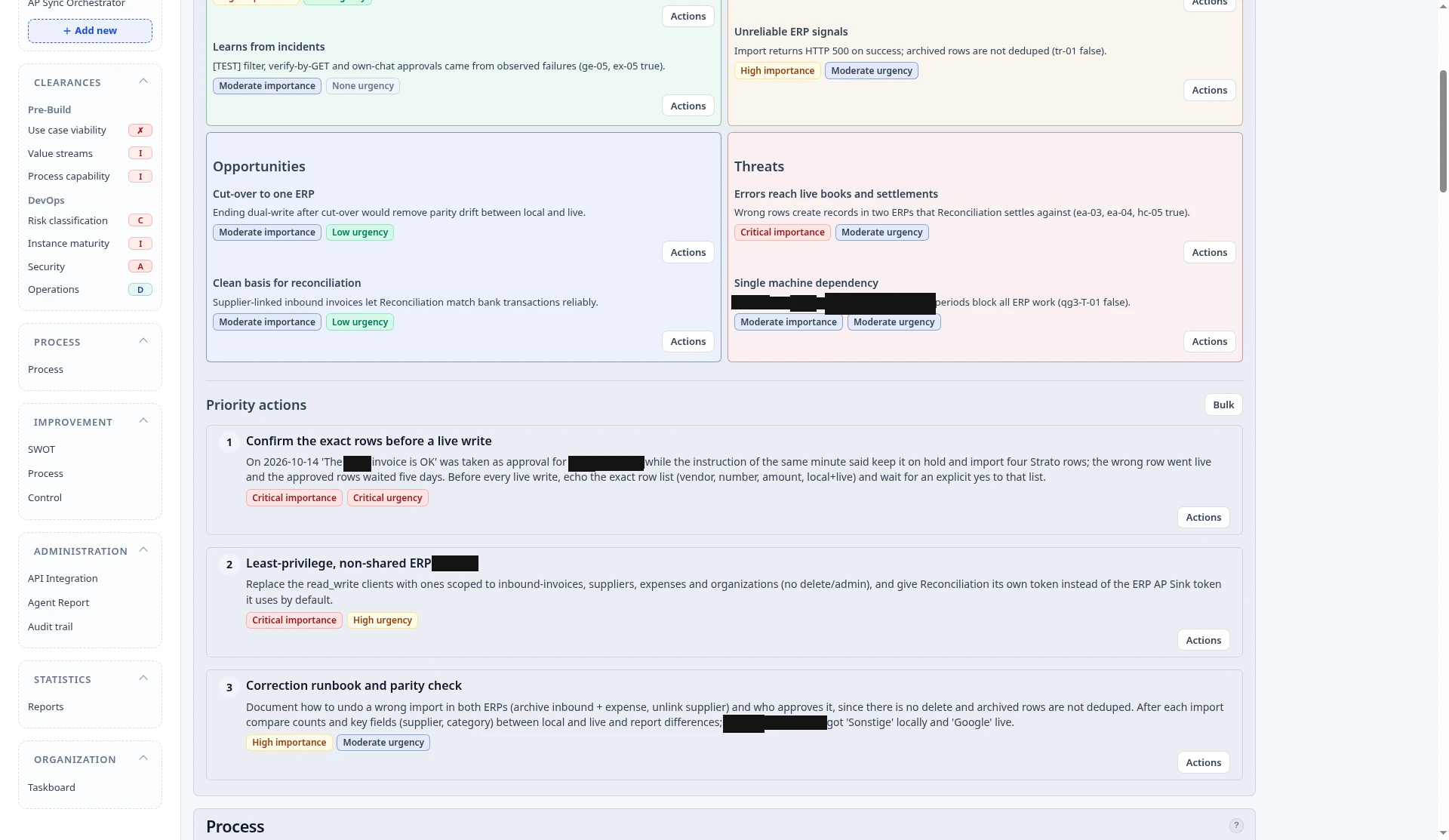
In a demonstrated payables definition the chain is visible. The map and the rules say how the work is supposed to run. The procedure records checkpoints and failure responses, including a misleading HTTP 500. The assessment names weaknesses and threats grounded in incidents. The action view proposes an approval echo, a parity check, and cut-over criteria, with a priority. That is a traceable path from doing the work, to describing it, to recommending a change. It is not automatic repair.
A proposal is not permission to change the job
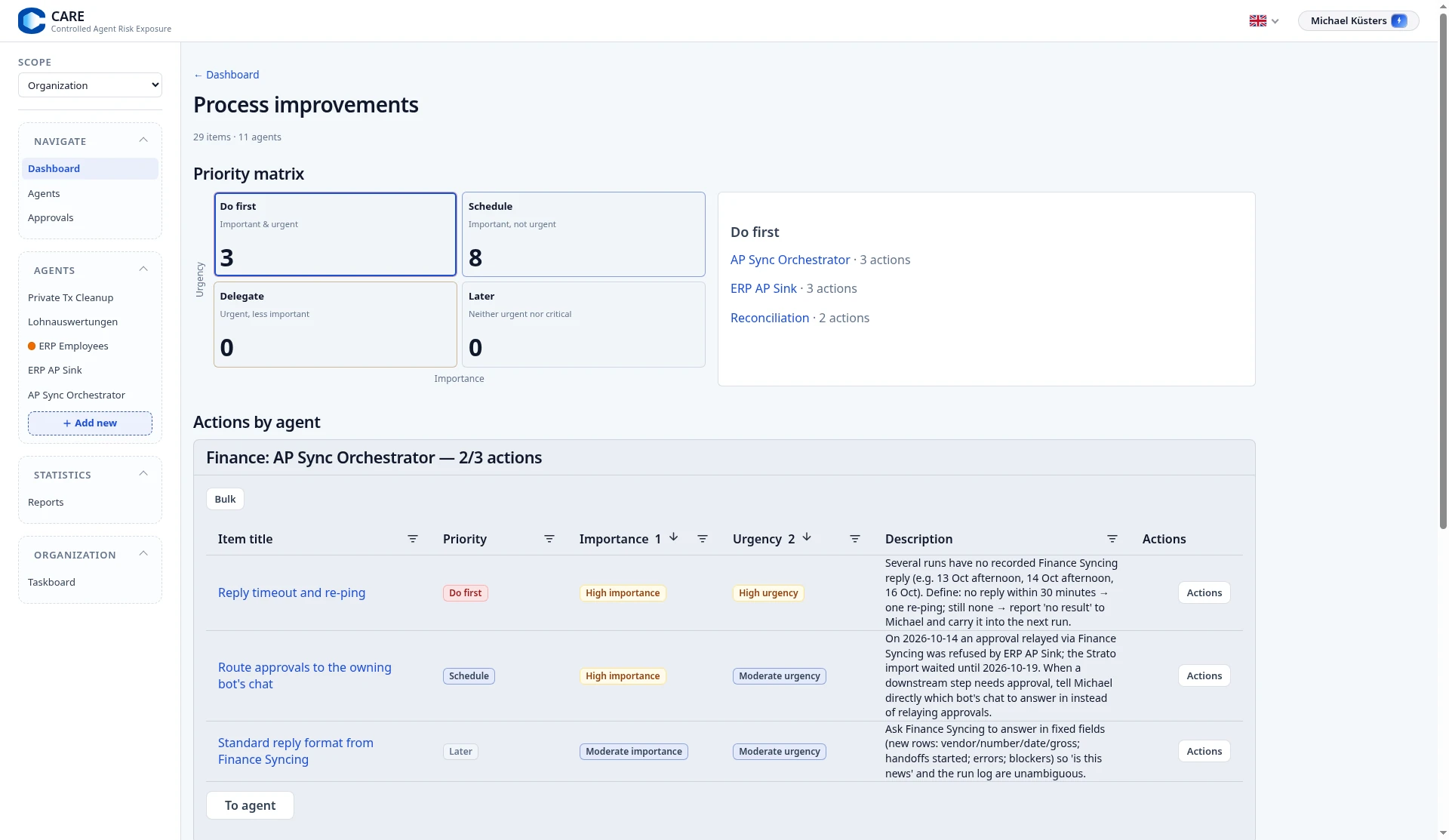
The performer can misread context, overstate a risk, or miss an obligation it has never been shown. The owner reviews the proposal against policy, against the incident, and against the consequence of getting it wrong. Preparation of the recommendation and authority to adopt it stay apart. A staged definition is how that separation is kept when the volume of proposals grows. The separation itself can be practiced on a page: the current job on the left, the proposal on the right, a signature in between.
Make proposals part of the ordinary cycle
The process owner stops waiting for an occasional review and asks the performer after the next real exception:
- Capture the exception and the dependency in the operating definition, cited to the run.
- Require the proposal as a behavior: what the run must do differently, and what evidence would show it. “Improve approval” goes back.
- Accept, narrow, or reject. The suggestion does not change authority until you do. Track implementation separately from the suggestion.
That is management getting out of the way of the work and staying in the way of the decision. Repeated across agents, the same rhythm is how the operation improves as it scales, using knowledge that was already being generated on every run.
Take action now
- Tell your agent to register itself in CARE: https://ai-managementsystem.com/under-care.
- Let the agent establish the management baseline.
- Use the outcomes.